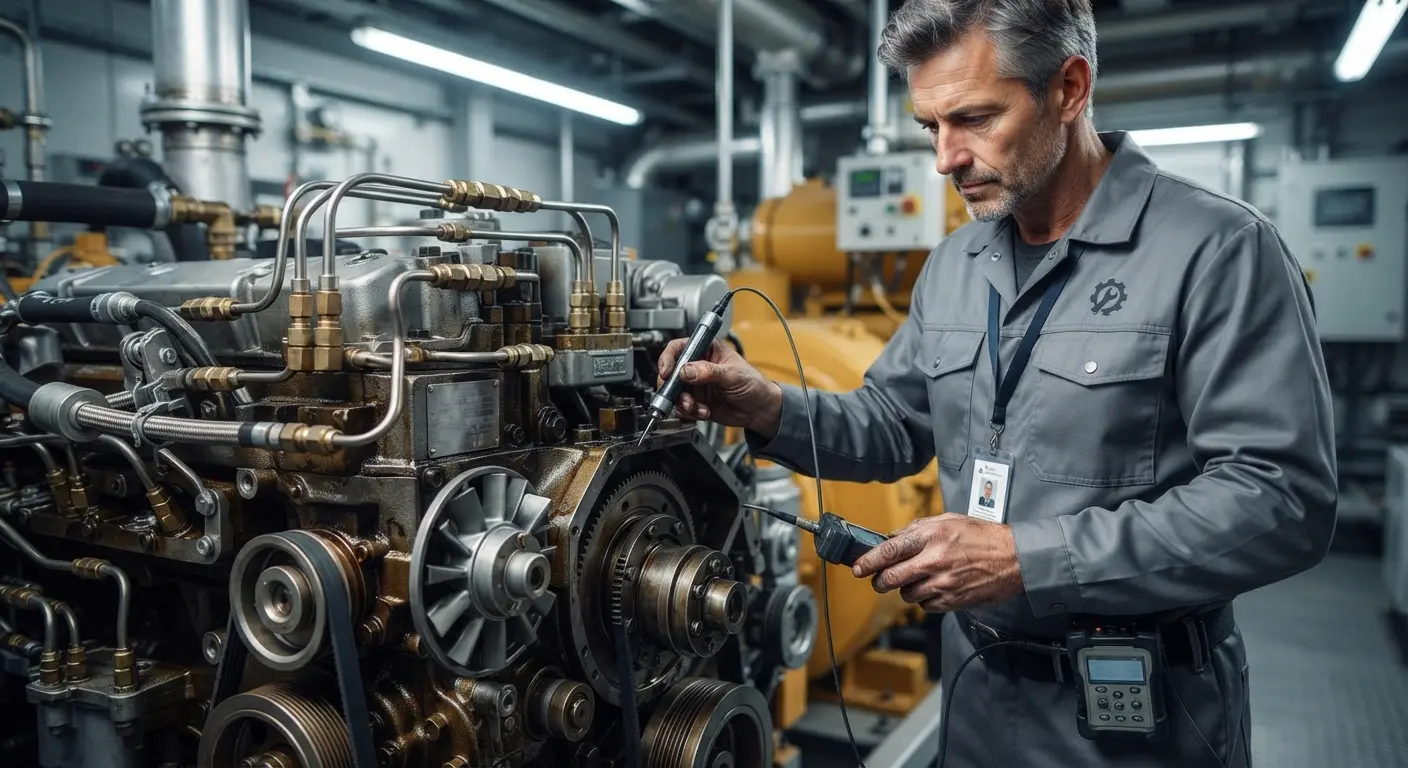
In a continuous-duty power plant, operators develop an intuitive feel for the acoustic signature of their machinery. A healthy heavy-duty gas engine—whether running at base load or stepping up through ramping cycles—produces a steady, rhythmic mechanical hum. When that acoustic baseline shifts into metallic clattering, sharp whining, or heavy thumping, it is often the earliest warning sign of internal component distress.
Ignoring unusual engine noises is a gamble that rarely pays off. In industrial settings, a minor vibration or an uncharacteristic screech can quickly escalate into a catastrophic failure if diagnostic steps are delayed.
At Mega Solutions UAE, we work closely with plant managers and maintenance leads who rely on heavy gas engines. Understanding what those strange noises mean can help your team catch wear issues before they turn into costly downtime.
1. Metallic Knocking or Deep Thumping (Internal Wear)
If you hear a heavy, rhythmic metallic knock or deep thumping emanating from the crankcase area, it points directly toward high-stress internal components.
- Potential Causes: Worn main bearings, connecting rod bearing degradation, or piston slap resulting from excessive cylinder clearance.
- Action Required: This is a severe red flag. Continuing to run an engine with a deep metallic knock risks structural block failure, fractured crankshafts, and massive overhaul costs. Immediate shutdown and inspection are required.
2. High-Pitched Whining or Screeching (Auxiliary & Air Systems)
A sharp, high-frequency squeal or whine is typically external rather than internal, often related to high-speed rotating elements or pressure leaks.
- Potential Causes: Slipping or misaligned accessory belts, failing turbocharger bearings spinning at high revolutions, or high-pressure air/gas leaks around intake manifolds and gaskets.
- Action Required: Inspect turbocharger clearances and check seal integrity. Catching a failing turbocharger bearing early allows you to source a replacement cartridge before foreign debris enters the combustion chamber.
3. Rapid Ticking or Valvetrain Clatter (Top-End Issues)
A lighter, faster-paced tapping or ticking noise coming from the top end of the engine (near the cylinder head covers) usually signals clearance issues in the valvetrain.
- Potential Causes: Excessive valve lash clearance, worn rocker arms, or insufficient lubrication delivery to the upper components.
- Action Required: Check oil pressure and flow rates to the cylinder head. Adjusting valve clearances and inspecting pushrods during routine maintenance windows keeps efficiency high and prevents premature valve seat wear.
4. Rattle or Vibration Under Load (Combustion & Ignition Anomalies)
If the noise only manifests when the generator accepts heavy grid loads, the issue may stem from combustion instability rather than pure mechanical friction.
- Potential Causes: Engine knock (detonation), pre-ignition, or misfiring spark plugs causing uneven cylinder pressure waves.
- Action Required: Review your ignition timing, examine spark plug wear states, and check gas fuel quality. Uncorrected detonation places immense thermal and mechanical stress on pistons and cylinder heads.
Building a Proactive Maintenance Culture
Anomalous noises are your engine’s way of communicating stress. Implementing regular acoustic monitoring—combined with scheduled visual inspections and prompt replacement of high-wear seals, filters, and ignition components—protects your plant’s operational continuity.
When unusual wear is detected and you need genuine replacement components fast, our Sharjah-based warehouse maintains physical stock ready to bridge the gap between failure and restoration.
Note: Mega Solutions UAE is an independent trader. We are not an authorized distributor of, or affiliated with, the INNIO Jenbacher brand. All trademarks are the property of their respective owners.